



India's real estate software market is one of the fastest-growing in Asia. According to Grand View Research's 'India Real Estate Software Market Size & Outlook, 2026-2033', the market is projected to grow from USD 623.7 million in 2025 to USD 1,918.4 million by 2033 - a CAGR of 15.1%.
For sales teams managing hundreds of inbound leads every week from portals like 99acres and MagicBricks, this report reflects how crucial technology including CRM platforms is becoming in this industry.
What is a real estate CRM?
According to the National Association of REALTORS, 23% of agents rank Customer Relationship Management (CRM) software among their top lead-generation tools.
It is specifically built for property sales cycles, where multiple follow-ups, site visits, inventory tracking, and long decision timelines are common.
Modern real estate CRMs like Superleap are designed to handle long sales cycles, multiple follow-ups, and high enquiry volumes common in property sales.
How does a real estate CRM work?
A real estate CRM typically follows the buyer through a sequence such as:
Lead captured → Lead assigned → First contact → Qualification → Site visit scheduled → Site visit completed → Follow-up → Negotiation → Booking → Post-booking follow-up
Instead of asking an agent to remember what happened at each stage, the CRM stores the activity against the lead or account. A manager can see who contacted the buyer, what property they were interested in, whether a site visit happened, what the next action is, and whether the opportunity has stalled.
For example, imagine a buyer enquires about a 2BHK apartment at 11:30 AM while the assigned salesperson is conducting a site visit. The CRM can capture the enquiry, assign it to the appropriate salesperson, trigger an acknowledgement, create a follow-up task, and preserve the conversation history. When the salesperson becomes available, they are not starting from a blank screen.
Essential features of real estate CRM software (2026)
Lead capture & portal integrations
The best CRMs for real estate pull information directly from property sites like 99acres, Magicbricks, Housing.com and social ads and display them in one system. This ensures that no lead is lost, and you can also prioritize prospects with a high intent, and move them toward closure.
For instance, Superleap automatically captures enquiries from property portals and digital ads, ensuring every lead enters the CRM instantly.
For a team receiving enquiries from several portals and paid campaigns, this matters because the lead source becomes part of the sales context. A prospect who arrived through a project-specific campaign may need a different follow-up from someone who made a general property enquiry.
Multi-channel communication
Once a lead is captured, communication becomes the differentiator. Top CRMs let you log calls, emails, SMS, and even WhatsApp chats against each contact.
In India especially, WhatsApp integration is a must. Many CRMs can auto-send welcome messages or booking links via WhatsApp when a new lead arrives. Built-in phone dialers and SMS tools also speed up contact. All interactions are timestamped, giving agents full history of client conversations.
Pipeline & automation
A CRM lets you view all the stages a prospect goes through in one glance and also lets you customize it specific to their journey. You can also trigger workflow automations, like sending reminders if a task is pending or sending emails after a visit is booked.
Capterra states that 98% of software buyers emphasize on automation being an essential feature in a CRM.
For real estate, pipeline stages should reflect the actual buying journey rather than a generic sales pipeline. Depending on the business, stages might include new enquiry, contacted, qualified, site visit scheduled, site visit completed, negotiation, booking pending, booked, and lost.
This makes stalled opportunities easier to spot. If 40 leads have completed site visits but 15 have had no follow-up in the last seven days, a manager has a concrete problem to address rather than relying on a salesperson's verbal update.
Mobile app & on-the-go access
Agents need to update information while on site visits. The best CRMs for real estate have strong mobile apps so you can access and add contacts, notes, and photos from your phone. This real-time syncing means no data is lost and team members can instantly see updates, keeping everyone aligned.
Mobile access becomes particularly important because an agent may meet a buyer at a project in the afternoon, receive a call from another prospect while travelling, and need to update the outcome of a site visit before moving to the next appointment.
If that information waits until the end of the day, small gaps start accumulating: follow-ups are forgotten, notes become incomplete, and managers see an outdated pipeline.
Inventory & booking management
For developers or brokers handling multiple projects, real-estate focused CRMs often include inventory modules. You can see which flats or plots are available in real-time, block units during bookings, and even generate booking forms - all within the CRM. This prevents double-bookings and ensures customers see accurate availability.
Broker/partner management
In India, many firms are dependent on channel partners or external brokers. A CRM should support this by assigning leads to partners, tracking each partner’s performance, and automating commission calculations. Dashboards allow all affiliates to record their own leads and commissions, which streamlines coordination.
This is especially useful when several brokers are selling the same projects. Without clear attribution, questions such as "Who brought this lead?", "Who followed it up?" and "Which partner is actually generating bookings?" can quickly turn into disputes.
Analytics & reporting
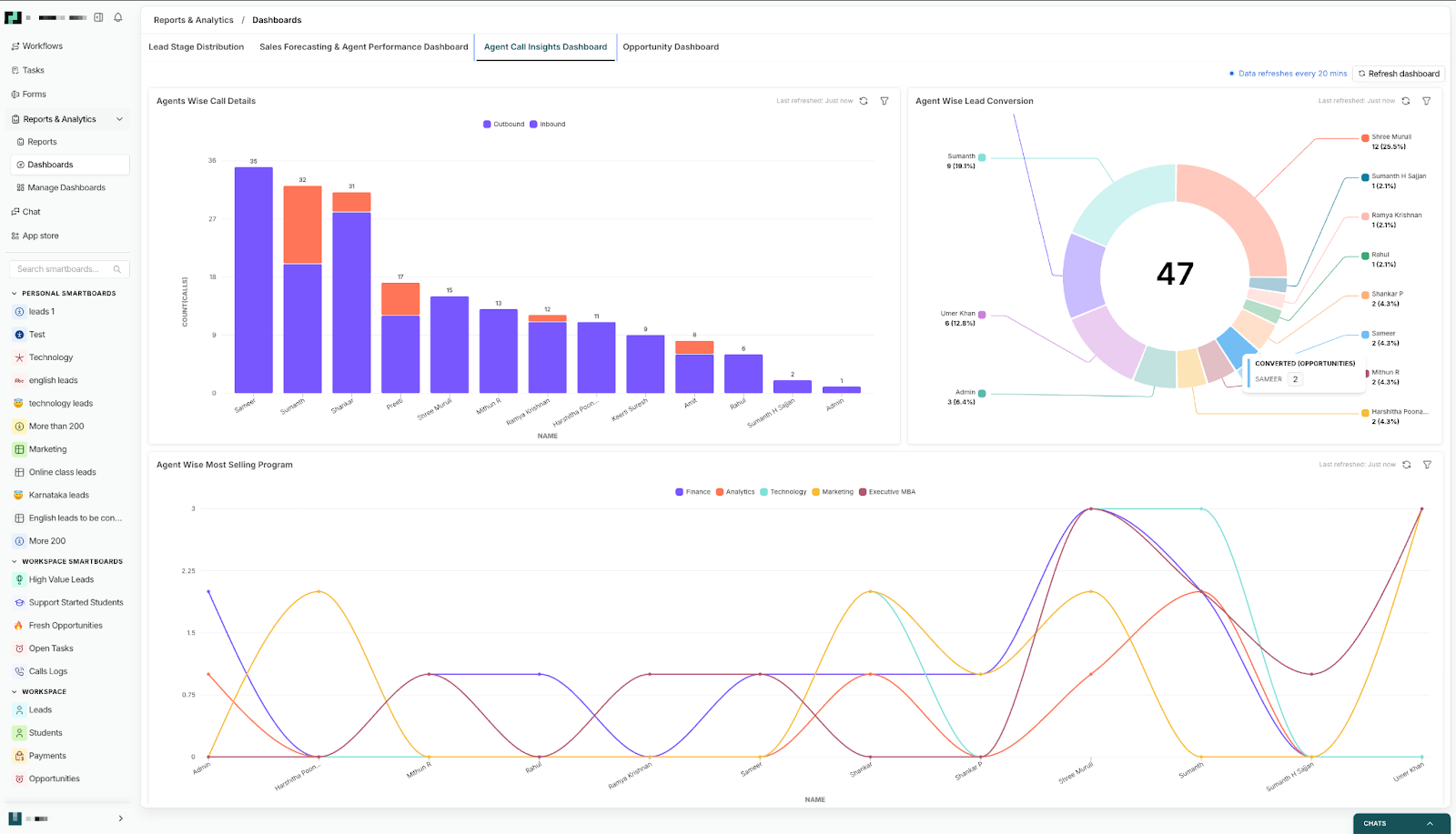
Your CRM dashboard will display key metrics like lead source breakdown, conversion rates, deal velocity, and agent productivity.
Let’s say you are running a Google Ad, you will be able to see whether it is generating inquiries and which agents are most efficient.
With such crucial insights in hand, it’s much easier to double down on the most impactful technique and also focus on areas that need improvement. Reports also help in regular team reviews, keeping everyone accountable and focused on targets.
The Superleap dashboard helps teams track lead sources, agent productivity, and deal velocity in real time.
Localization & compliance
The CRM should be able to handle local nuances, especially in a country like India. This means support for GST billing, regional languages (if needed), and local address/area units (Sq. Ft., BHK, Katha, etc.). Custom fields to capture things like ‘Tower’ or ‘Plot Size’ ensure the CRM fits the way Indian property data is recorded.
Lead assignment and distribution
A feature that deserves its own place in a real estate CRM checklist is automated lead assignment. When several agents are handling incoming enquiries, leads should not sit in an inbox waiting for someone to claim them.
Depending on the sales structure, leads can be distributed based on factors such as project, location, language, property type, agent availability, or round-robin rules. The goal is simple: the right salesperson receives the enquiry quickly and ownership is visible to the rest of the team.
Lead scoring and prioritization
Not every enquiry deserves the same follow-up strategy. A CRM can help teams prioritize leads using information such as budget, preferred property, location, engagement, enquiry source, previous interactions, and stage in the buying journey.
For example, someone who has repeatedly viewed a project, asked for pricing, and scheduled a site visit represents a different opportunity from someone who downloaded a brochure six months ago. Treating both leads identically makes the sales team's workload harder than it needs to be.
7 Key Benefits of Real Estate CRM for Indian Sales Teams
Most Indian real estate sales teams don't lose deals because of bad product or wrong pricing - they lose them because a hot lead sat uncalled for six hours while the agent was on a site visit, and the buyer gave their token to whoever called first.
1. Never lose a portal lead again
A real estate CRM eliminates the biggest leakage point: missed or delayed portal enquiries. Leads from platforms like 99acres, MagicBricks, and Housing.com are auto-imported instantly into the system. No more manual checking, no more Excel updates. What used to take 60-90 minutes now happens in seconds - which means your team can act while the buyer is still actively searching.
2. First-response advantage
Speed is everything in Indian real estate. The first agent to respond has a first hand chance at winning the deal especially during high-intent browsing windows.
A CRM triggers an automated WhatsApp message within seconds of an enquiry, acknowledging the lead and starting the conversation immediately. Even if your sales rep is busy, the buyer doesn’t feel ignored. That early engagement dramatically increases the chances of converting the enquiry into a site visit.
3. No double-bookings during festive season spikes
During peak periods like Navratri, Diwali, or Akshaya Tritiya, enquiry volumes surge - and so do booking conflicts.
A real estate CRM maintains live inventory visibility. The moment a unit is blocked or held, it reflects across the system. This prevents embarrassing double-bookings, avoids internal confusion, and builds trust with buyers who expect clarity and transparency when making high-value decisions.
Also, when demand spikes hard, automated lead assignment, follow-ups, and reminders ensure no enquiry slips through, even when volume is at its highest. This is where operational efficiency directly translates into revenue.
4. Broker and channel partner accountability
Channel partners play a huge role in Indian real estate - but tracking commissions and contributions can quickly become messy.
A CRM logs every interaction, maps each deal to the correct broker, and automatically calculates commissions. Disputes are no longer based on memory or WhatsApp chats - they’re resolved using clear data. This creates transparency, reduces friction, and strengthens long-term relationships with brokers.
5. Manager visibility without morning status calls
Sales managers often rely on daily check-ins just to understand what’s happening on the ground. A CRM removes that dependency.
With a live dashboard, managers can see every call made, every follow-up pending, every site visit completed, and every deal that’s stuck. Instead of spending 30 minutes asking every salesperson for an update, a manager can start with the exceptions: leads without follow-ups, deals stuck at negotiation, site visits with no next action, or agents with unusually low activity.
6. Data-driven forecasting
Most real estate teams rely on gut feel to predict monthly sales. A CRM replaces that with actual pipeline visibility.
By tracking leads across stages - enquiry, site visit, negotiation, booking - you can estimate how many units are likely to close before the month even begins. This helps with inventory planning, revenue forecasting, and setting realistic targets for the team.
What should you measure after implementing a real estate CRM?
Buying CRM software is not the outcome. The outcome is a better sales process. To evaluate whether the CRM is actually helping, track metrics such as:
- Lead response time
- Lead-to-contact rate
- Contact-to-site-visit conversion
- Site-visit-to-booking conversion
- Follow-up completion rate
- Leads with no next action
- Average time spent in each pipeline stage
- Conversion by lead source
- Agent-level conversion rates
- Broker/channel-partner contribution
- Cost per qualified lead
- Revenue or bookings by campaign
Best real estate CRM software in India: what to look for in 2026
The reality is simple: Indian real estate sales workflows are fundamentally different. Between RERA compliance requirements, GST-linked billing, portal-heavy lead generation (like MagicBricks and Housing.com), and WhatsApp-first communication, the entire system is built differently from Western markets.
A CRM designed for the US assumes email-first communication, structured procurement cycles, and minimal broker involvement. Indian teams operate on instant responses, informal broker networks, and festival-driven buying spikes.. and your CRM MUST reflect that reality.
What to look for in a real estate CRM (India, 2026)
You should also evaluate lead routing, duplicate detection, pipeline customization, reporting depth, integrations, user permissions, data export, implementation support, and how easily the system can adapt when your sales process changes.
A useful test is to take one real lead from your business and follow it through the CRM from enquiry to booking. If your team has to leave the CRM repeatedly to check WhatsApp, spreadsheets, calendars, inventory, or another database, there may still be operational gaps.
Free vs. paid real estate CRM in India: when each makes sense
If you’re searching for a free CRM for real estate, the answer depends entirely on your team size and lead volume.
For small teams (under 5 agents):
Free tools are usually enough. You can track leads, assign follow-ups, and maintain basic visibility. At this stage, simplicity matters more than automation.
For growing teams (10+ agents with portal dependence):
Free tools start breaking down. You’ll need portal integrations, WhatsApp automation, and structured workflows. Paid plans in India typically range from ₹800 to ₹2,500 per user per month, and this is where you start seeing real efficiency gains.
For large developers (broker-heavy sales models):
Enterprise-grade CRMs become essential. When you’re managing multiple projects, large broker networks, and high enquiry volumes, you need advanced reporting, commission tracking, and forecasting. These plans usually start at ₹5,000+ per user per month.
The trade-off with free tools:
What you save in cost, you lose in capability. Most free CRMs do not offer:
- Portal integrations
- WhatsApp automation
- Broker dashboards
Which means your team ends up with multiple tools - and losing speed, accuracy, and accountability in the process.
How to choose the best real estate CRM?
Local Compatibility: Based on your country/region, check if the CRM supports your local language (only if your team needs it). Commission structure, tax rules and other regulations vary across locations, therefore, customization flexibility is important.
Mobile & Offline Access: Pick a mobile CRM that is well rated and works in both IOS and android.
Scalability & Customization: Finally, envision where you want to be in 1-2 years? Is your CRM scalable?
For example, if today you only list apartments, but plan to expand to plots and commercial, the CRM should allow custom deal stages or fields for different property types. Flexibility in customizing pipelines and adding fields (like “Under Construction” vs. “Ready to Move”) is important.
Questions to ask before buying a real estate CRM
Before scheduling a demo, ask:
- Where do our leads currently come from, and can the CRM capture those sources automatically?
- How are duplicate leads identified?
- How quickly can a new enquiry be assigned?
- Can agents manage calls and WhatsApp conversations from one place?
- Can we customize stages for different projects or property types?
- Can managers see leads without follow-up or a next action?
- Can we track marketing source through to booking?
- How does the system handle inventory changes?
- Can brokers or channel partners have controlled access?
- What happens to our data if we decide to leave the platform?
- How long will implementation and training take?
- What integrations are included versus charged separately?
The last few questions are easy to overlook. A CRM can have every feature your team wants and still fail if implementation is difficult, adoption is poor, or important workflows depend on manual workarounds.
Conclusion
With heavy incoming volumes, the only way to cater to each lead efficiently is by adopting a CRM. While the sales cycle is long, it is important to always know what stage each lead is at (whether to nurture or send them signing papers) to achieve sales targets.
In real estate, time truly is money - and CRM is one of the fastest ways to multiply your time.




.avif)
%201%20(1).svg)
.svg)
.svg)
.svg)
.svg)